
In Northern Botswana, where wildlife once moved freely across vast landscapes, traditional migration routes have been disrupted by fences and land-use changes, while local communities have often been excluded from their management. These changes have intensified challenges like human-wildlife conflict, unsustainable land practices, and the economic impact of shifting climate conditions.
Round River Conservation Studies is working alongside community trusts and local institutions to address these root issues by promoting biodiversity conservation alongside community-led management. By partnering with communities and private conservancies, we gather essential data on wildlife populations and movements to inform management strategies that benefit both wildlife and community trusts. Through these collaborations, we’re helping to reinforce northern Botswana’s ecological balance, with an approach rooted in both scientific insight and traditional knowledge.


Our closest partners in this region are The University of Botswana’s Okavango Research Institute (ORI), Natural Selection, Department of Wildlife and National Parks (DWNP), and the Community Trusts of Sankuyo, Mababe and Khwai.
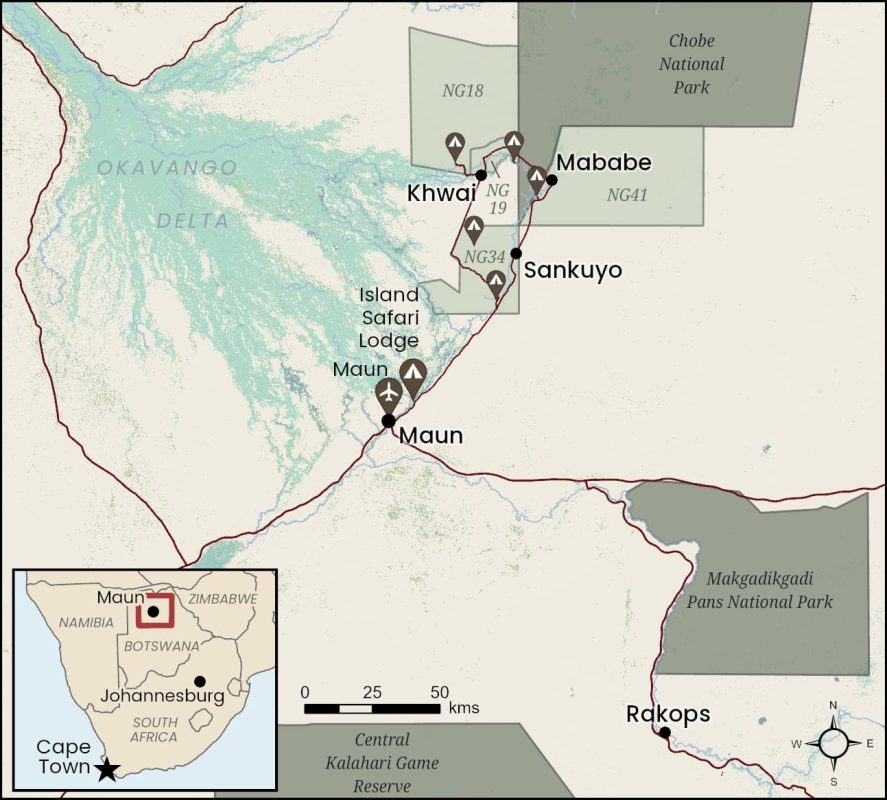
In Northern Botswana, where wildlife once moved freely across vast landscapes, traditional migration routes have been disrupted by fences and land-use changes, while local communities have often been excluded from their management. These changes have intensified challenges like human-wildlife conflict, unsustainable land practices, and the economic impact of shifting climate conditions.
Round River Conservation Studies is working alongside community trusts and local institutions to address these root issues by promoting biodiversity conservation alongside community-led management. By partnering with communities and private conservancies, we gather essential data on wildlife populations and movements to inform management strategies that benefit both wildlife and community trusts. Through these collaborations, we’re helping to reinforce northern Botswana’s ecological balance, with an approach rooted in both scientific insight and traditional knowledge.

We are currently working with in-country partners to collect data on land-use practices, wildlife movement patterns, and community priorities around relationships with tourism companies.


Since 2013, Round River has assisted Community Development Trusts in implementing wildlife monitoring, carnivore and rare species opportunistic sightings, and establishing and implementing bird monitoring systems. All field activities have been in collaboration with community escort guides from Sankuyo Tshwaragano Management Trust, Mababe Zokotsama Community Development Trust, and Khwai Zou Development Trust. Community escort guides accompany Round River biologists and students in each concession area, and the student leaders provide technical training on wildlife monitoring methodologies, including equipment and computer use. At the end of each field year, we submit all collected data to the community trusts, ORI, and DWNP. In each community, we provide training to participating community escort guides on the skills required for herbivore monitoring.
Round River is currently in collaboration with ORI and other Botswana NGO’s to identify additional concessions that require assistance with monitoring programs, in hopes of creating a more complete picture of wildlife populations in the eastern fringes of the Okavango Delta. We are also actively pursuing and committed to smaller community projects within the region.

Our 12-week semester programs in Botswana center on wildlife monitoring and conservation planning. We have been operating our student program in Botswana since 2012, and have built the program over that time to be deeply integrated into the needs and interests of our research and community partners. While immersed in the vast landscapes of the Okavango Delta, students experience unparalleled proximity to wildlife, gaining first-hand experience in community-based conservation and land management.

Our 12-week semester programs in Botswana center on wildlife monitoring and conservation planning. We have been operating our student program in Botswana since 2012, and have built the program over that time to be deeply integrated into the needs and interests of our research and community partners. While immersed in the vast landscapes of the Okavango Delta, students experience unparalleled proximity to wildlife, gaining first-hand experience in community-based conservation and land management.
Maggie Triska
Conservation Director
Email: maggie@roundriver.org
Student Programs Co-Director
Email: benszyd@roundriver.org
We use cookies to improve your experience on our site. By using our site, you consent to cookies.
Websites store cookies to enhance functionality and personalise your experience. You can manage your preferences, but blocking some cookies may impact site performance and services.
Essential cookies enable basic functions and are necessary for the proper function of the website.
These cookies are needed for adding comments on this website.
Google reCAPTCHA helps protect websites from spam and abuse by verifying user interactions through challenges.
Statistics cookies collect information anonymously. This information helps us understand how visitors use our website.
Google Analytics is a powerful tool that tracks and analyzes website traffic for informed marketing decisions.
Service URL: policies.google.com (opens in a new window)


